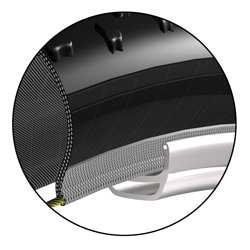
WHICH IS THE BEST VALVE?
There are three types that have become market standards and it is difficult to make any particular recommendation. The most important aspect is that the valve fits the rim valve hole and that an appropriate pump is available. Contrary to popular belief, major air retention differences are now a thing of the past. In any case, all Schwalbe valves provide excellent performance and are adapted to high-pressure use.
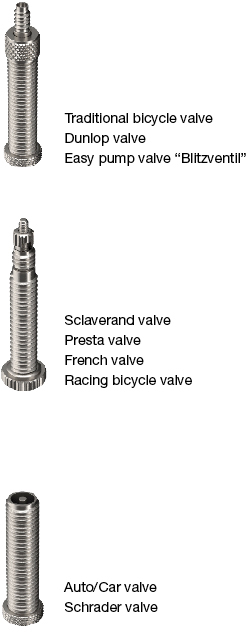
The classical bicycle valve or Dunlop valve is still the most common worldwide. Most cyclists are familiar with it. The valve core can easily be replaced and air can be released very quickly. Fitting a tube with a Dunlop valve is more awkward, as the valve core and locknut need to be removed in order to fit the valve through the valve hole. Inflation is only possible once the core and the nut are back in place.
With traditional Dunlop valves, it is impossible to check the inflation pressure. However, the special Schwalbe Dunlop valve allows a return airflow, so that it is now possible to check the inflation pressure with an Airmax pressure gauge.
Formerly it was difficult to inflate a tube with a Dunlop valve, but with today´s modern valve cores, this is no longer the case.
The Sclaverand valve is narrower than other valves (6 instead of 8 mm). It needs a smaller rim hole and is therefore particularly well suited for narrow racing bike rims. It is also approx. 4-5 g lighter than a car valve or Dunlop valve.
It can be locked manually with the knurled nut. Before inflating, the knurled nut must be loosened. First time users frequently have some problems. Also the thin top pin can be easily bent when attaching and removing the pump connector.
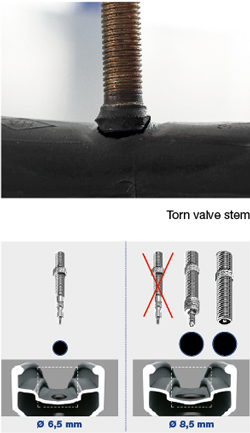
Caution: Be aware that using Sclaverand valve tubes on rims with larger valve holes often leads to a valve tear off when the sharp metal edges around the valve hole cut the valve stem off the tube.
The Auto/Car valve can be inflated very easily at a filling station and is pleasantly unproblematic. Older, as well as simple bicycle pumps are not compatible with car valves.
WHAT IS THE PURPOSE OF A RIM NUT?
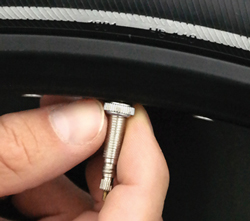
The rim nut fixes the valve in the rim. Some regard it as unnecessary. And indeed, you may well ride your bicycle without a rim nut. It is however helpful when attaching the pump connector, as particularly when the pressure is low the valve may fall inside the rim. With some rims there may be a rattle if the valve is not fixed.
The rim nut must only be tightened by hand. Never tighten the rim nut with pliers, as this can lead to tube damage.
WHAT CAUSES A VALVE TEAR OFF?
A valve tear off can occur if it was installed under tension.
Another frequent cause is installing a Sclaverand valve tube into a rim with a larger valve hole. The metal edge of the valve hole can shear the valve stem off the tube.
Caution: Be aware that there are also rims that have the correct valve hole of 6.5 mm on the outside, but a larger hole of 8.5 mm on the inside, which causes the problem. A nut that is excessively tightened just exacerbates the problem of tear off. The major role of the rim nut is to lock the valve in place at the time of inflation.
In most cases valve tear off is due to tire slip. Continual improvement in brake performance and low inflation pressures often cause the tire to slip on the rim. The tire movement then drags the tube and this can lead to the valve shearing off.
WHAT CAN BE DONE TO PREVENT TIRE SLIP OR VALVE TEAR OFF?
A higher inflation pressure considerably reduces the tire slip. Of course a higher tire pressure is not always desired.
We implement Limited Slip Technology (LST) in Schwalbe MTB-folding and balloon tires. The tire bead is coated with a special rubber layer that produces a dramatic reduction in tire/rim slip.
The Schwalbe Downhill tube has a highly reinforced valve foot.
Theoretically, the use of talcum powder is also helpful. This can reduce the friction between tire and tube. However in practice, if talcum powder gets between tire and rim, it will increase the problem.
Some rims have such slippery surfaces that even LST does not suffice one hundred percent. It will help if the rim contact area with the tire is lightly abraded with sandpaper (180 grade). This considerably increases the friction between tire and rim.
The problem is very much reduced with disc brakes because the rims do not get hot through braking.
There is no valve tear off with tubeless tires. The tire can move without causing problems.